10 December 2008

Emergency Ride Home

Check out the following article from No Impact Man on a growing solution to newly-converted greens who are hesitant to leave their car in the dust. Certainly not a complete solution, but one of many that are growing into viable realities. [Find the original article here.]

"If you'd like to ditch the car but worry about emergencies"

Suppose you'd like to commit to leaving your car in the driveway or getting rid of it altogether and instead making your commute by foot, bike, carpool or public transit.

You want to save the money, skip the traffic jams, get the exercise, cause fewer greenhouse gas emissions, and have less stress. It's just that you're worried about emergencies.

What if you're stuck at work without your car and your child has an emergency? Or your older parent? Or you got last minutes tickets to the game or even a voicemail from that hot wannabe date who finally said yes?

Well, suppose somebody promised they'd pay to get you home by taxi if that happened?

According to "Penny Nickel" at Money and Values, that's just what more than 50 cities and counties will do if you agree to leave your car it home:

"Guaranteed Ride Home (or Emergency Ride Home) programs are designed to get commuters off the road and onto public transit or another method of transportation, by helping assuage fears about how to get home in emergency circumstances. They are often sponsored by counties, cities, or transit agencies, but may also be sponsored by individual employers. If you enroll in such a program, then the sponsor will cover the costs of you getting home if unexpected circumstances interfere with your regular plans. Each program has its own rules, but typically "emergencies" are defined as unpredictable events like illness/injury of yourself or a family member, unscheduled overtime (verified by your employer), an emergency at your home (like a flood/break-in/fire/etc), or the early departure of your carpool driver. Covered events for bikers and walkers may also include severe weather.

"If you register for the program, you'll qualify for a set number of trips home per year (often two to six.) If an emergency arises, typically you call the Guaranteed Ride Home coordinator and they'll call you a cab, although in some programs you can skip that step and just call the cab yourself (either filing for reimbursement later or using some sort of voucher.) Some programs cover the tip, some don't. They may also cover the costs of a stop at your child's school or daycare on the way home."

Go here for Money and Values' excellent list of municipalities offering the scheme. And don't forget, if your local government isn't on board, to check and see if your employer offers the program.

08 December 2008

GoodGuide

If you're looking for a quick and easy reference to the sustainability and eco-friendliness of your household products, consider GoodGuide.

The website says, "GoodGuide provides the world's largest and most reliable source of information on the health, environmental, and social impacts of the products in your home."

It also lists the following utilities:
  • Find Safe, Healthy & Green Products that protect you and your family.
  • Search or Browse over 60,000 Personal Care & Household Chemical Products, and see what’s really beneath the label.
  • Get Expert Advice & Recommendations on products and quickly learn the impacts of what you buy.
  • Find better products, and make purchasing decisions based on what’s important to you.
  • Create a personalized Shopping List with the products that are right for you & your family.
Checking it out, I was pleasantly surprised by the details of analysis on each product. Because GoodGuide is only in its beta, not every product you may want info on will be on the site yet. But it's sure to get better and more comprehensive over time. Check it out!

07 December 2008

"Eco-Pregnancy Makes for Healthy Babies"

Check out this article from Low Impact Living:

Many women discover the green lifestyle when they are expecting, or become moms. Wanting to do the best you can for your child includes considerations that you make before your baby is even born – after all, that’s why you’ve given up wine, right? Everyone knows that eating right and getting enough rest will help both mother and baby be healthy, but the green movement has opened our eyes to the effects that the world around us can have as well.

Back in 2005, a frightening study by the Environmental Working Group (EWG) found chemicals in the blood of the umbilical cords from 10 newborn babies. These chemicals were linked to cancer, birth defects, and hormone disruptions, and included lead, mercury and PCBs. Since then, moms-to-be have demanded more information about reducing the impact of the chemical soup that we all live in.

We Are What We Eat

According to most studies, it’s not clear whether organic food has higher nutritional value than its non-organic counterparts. Regardless, one thing is for sure: organic food contains fewer chemicals. Organic food is grown without artificial fertilizers, conventional pesticides, or sewage sludge, and processed without ionizing radiation and food additives. That stuff is gross, whether you’re pregnant or not. To label a food product organic, it must be certified by the National Organic Program, which is run by the U.S. Department of Agriculture (USDA). A USDA Organic seal indicates that the product contains at least 95% organic ingredients, so look for this label.

Eating the fresh fruits and vegetables recommended for everyone, but particularly pregnant women, may also help you to avoid Bisphenol-A (BPA), a toxic chemical found in the linings of food cans. Most recently linked to plastic baby bottles, it can also be found in canned infant formula, as well as canned adult foods like soup, fruit and soda. BPA has been linked to breast cancer and infertility, and there is concern that exposure can affect fetal and infant brain development. Scary stuff, so try to avoid processed foods and stick to real, whole food whenever possible.

Once you have that food home, it’s important to prepare it carefully. Use cast iron or stainless steel cookware – Teflon and other non-stick surfaces have been shown to emit toxic chemicals when preheated to high temperatures, which can occur in just a few minutes. In fact, these chemicals are a known hazard to pet birds, causing lung hemorrhaging and death, so it can’t be good for us either. Particles of non-stick surfaces are also found in food itself.

Most pregnant women know to eat only low mercury fish, avoiding species like tuna and swordfish. For a complete list of sustainable and healthy seafood, download a Seafood Watch card from the Monterey Bay Aquarium. You should also filter your tap water, as pollutants may lurk there. Check out the EWG’s Tap Water Quality Database to see what your city’s water may include, then take a look at our recent post on water filters to help you decide on the one that’s right for you.

Personal Care and Cleaning Products

Without knowing it, we slather chemicals on ourselves in alarming quantities. Women, on average, use 12 personal care products per day. Look for better choices products in the EWG’s searchable Skin Deep Database. The database includes a rating for each product on its developmental/reproductive toxicity, which includes birth defects and developmental delays for children. Phthalates are particularly harmful for boys, while the EWG recommends that everyone avoid perfume, cologne, or products with added fragrance. The database also has a section for products just for kids.

Cleaning products are another key source of toxic chemicals in the home. Whatever you spray on your counters or floors makes its way into your system and thus into your baby. Check out our selection of eco-friendly cleaning supplies, use plants to clean the air, and open windows whenever possible.

Make Your Nursery a Safe Space

It’s just as important to provide a healthy nursery for your little one! Visit our post on green kids, including green furniture, bedding, low-VOC paints, plus the age-old debate over diapers: cloth or disposable? Be careful when painting or renovating while pregnant, as the chemicals can pass through to your baby.

Let’s Have a Baby Shower

OK, enough of the scary stuff, it’s time to celebrate! Turn your baby shower green by asking for pre-worn clothes and other used goods, or natural products. Check out environmentally-friendly invitations and favors, like those at ecoparti. Request non-plastic items and reusable packaging to inspire guests’ creativity. They can wrap used books in an organic cotton baby blanket, or give a bundle of healthy, eco-friendly baby skin-care products.

Now all that’s left is to actually have the baby!

06 December 2008

Un-clog Your Drains

Don't you hate it when your sinks get clogged up? Drain cleaner is one of the worst substances environmentally that you could ask for. What are your other options?

For starters, you could do it manually. With a plunger. Preferably a different one than you use in the toilet. See here.

Or mix a couple of kitchen supplies: 1/4 cup baking soda and 1 cup vinegar. Leave it down there for 15 minutes, then rinse with boiling water. See here.

Finally, there are eco-friendly ready-made products available. Look for "enzymatic biological drain cleaners on the market today, such as Earth Friendly Products' Enzyme Drain Cleaner... These make use of a natural bacterial and enzyme mixture to open and keep drains clear. And unlike sodium hydroxide they are non-caustic and will not facilitate combustion." See this article for more info.

What works best for you?

04 December 2008

Wrapping those holiday gifts


Choosing a method of wrapping gifts can be a challenge when you're learning to be green. Let's look at the options and figure out together, shall we?

Option 1: One certainly does not want to use traditional wrapping paper or gift bags. Full of chemicals, heavy metals, and synthetic inks, it is certainly the least green source. Plus, purchasing it means more trees must be harvested and processed, and more wrapping paper must be shipped out, all with a high carbon price tag.

[Do note that there are more eco-friendly wrapping papers and bags available out there, made of hemp, etc. These solve many of the problems with traditional wrapping papers. However, you are still wasting resources unnecessarily, even if those resources are renewable. Options 3 and 4, below, are better choices.]

Option 2: Last year, I hand-decorated a couple of brown paper grocery bags and used those to wrap my family's gifts. A much better option than traditional wrapping paper. Plus, the gifts I gave had extra value added because of the time and care I put into creating my own wrapping paper. This year, however, we bring reusable grocery bags into stores with us, so we only have one spare paper bag lying around to be used.

Intentionally getting paper bags at the grocery store in order to wrap with them is not appropriate. It requires the production of resources separate from those that would otherwise need to be made. Bring your cloth bags to the store. It doesn't count as "reusing" if you didn't have to use it in the first place. So, paper bags are a no-go.

Option 3: Found paper, on the other hand, is a good idea. If you get the newspaper, use pages of that to wrap gifts. But, again, do not buy a newspaper specifically for wrapping paper!

Try to use the wrapping paper from last year's gifts if you removed it carefully and kept it. And this Christmas try to save the wrapping paper that other people use on your gifts.

But after you open those gifts wrapped in traditional wrapping paper, consider asking the gift-giver to wrap your gifts using a no-waste method next year. My parents have been doing so for years and don't mind. They realize that opening gifts on Christmas morning would be less enjoyable for Ben and me if we were feeling guilty about the paper our gifts had required. Keep this in mind as you wrap gifts for others. You want them to feel happy, not guilt-ridden.

*Note: You can recycle paper with tape on it. Remember that over the holidays!

Option 4: Over the past year, I've been trying to wrap all the presents I give others in cloth. I get odd size measures of cloth from thrift store, thus taking the cloth out of the waste stream since it's too small to be used for large, grand projects. (It is really quite easy to find cloth in any thrift store. You typically have your choice of colors and patterns. It's not a sacrifice when it comes to style.) Cloth is a good choice because it is extremely apt for reuse, so it creates no waste.

For birthdays, etc. it has been possible for me to experiment with sewing the fabric into appropriately-sized sacks or draw-string bags. Again, I think this form of gift wrapping is more meaningful than using traditional wrapping paper because I am putting a large amount of time, thought, and effort into each gift. I hope this makes the recipients feel good about themselves because it is, in part, my way of expressing how special they are to me.

Christmas, however, is overwhelming. Gifts for all our parents and siblings equals a ton of sewing (and a ton of time for me, since I'm not too good with my sewing machine yet). It's possible to use cloth just like wrapping paper, except you use safety pins or just ribbons to hold it together instead of tape.

But there's a prettier way.

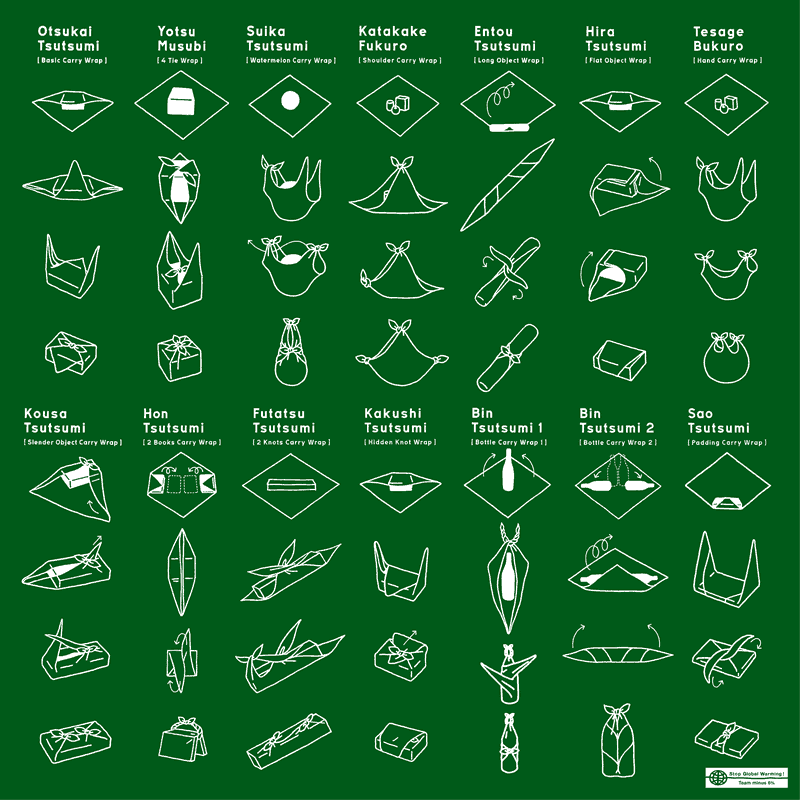
Furoshiki, the Japanese art of using cloth swatches to wrap and carry any- and everything, is an excellent idea for gift wrapping. The picture above shows just some of the shapes you can wrap and how your gifts will turn out looking. Check out this link for more information. Lots more info can be found by performing a simple Internet search for "furoshiki."

So, in conclusion:
-Traditional wrapping paper/gift bags = really bad
-Paper grocery bags = better, as long as you recycle it (but you're better off using cloth grocery bags exclusively when you go shopping and, thus, not procuring any of these bags to use)
-Reused paper (like newspaper or last year's gift wrapping) = good, as long as you recycle it (but these materials still have a limited life span)

-Cloth swatches or bags = really good


If you get stuck, just remember your three R's (recycle, reuse, reduce).

No, go enjoy the holidays!

Image found at http://gadgets.boingboing.net/2008/01/02/furoshiki-elegant-ja.html

03 December 2008

Organic or not Organic -- That is the Question


Fairly frequently articles come up outlining how important it is to buy certain foods organic while other foods are less dangerous in their "traditional" form. Find a list you trust, memorize a few key foods that you often buy, and get shopping!

Here's the information from one such article:

Should Buy Organic
-Milk
-Meats
FRUITS:
-Peaches
-Apples
-Nectarines
-Strawberries
-Cherries
-Grapes
-Pears
-Raspberries
-Plums
-Oranges
-Tangerine
-Cantaloupe
-Lemon
-Honeydew
-Grapefruit
-Watermelon
-Blueberries
VEGETABLES:
-Sweet Bell Peppers
-Celery
-Lettuce
-Spinach
-Potatoes
-Carrots
-Green Beans
-Hot Peppers
-Cucumbers
-Cauliflower
-Mushrooms
-Winter Squash
-Tomatoes
-Sweet Potatoes

Don't Have to Buy Organic
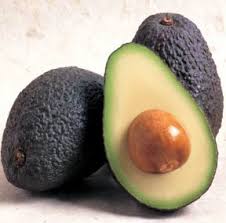
-Avocado
-Banana
-Pineapple
-Kiwi
-Mango
-Papaya
-Asparagus
-Broccoli
-Cabbage
-Onions

Image from http://tbn2.google.com/images?q=tbn:RIA2pRwDp4HIpM:http://whatscookingamerica.net/Fruit/AvocadoPhoto.jpg

01 December 2008

Square Foot Gardening


Some of you already know about "square foot gardening." Developed primarily by Mel Bartholomew in the 1980s and perhaps even more useful today than ever, square foot gardening is based on the concept of planting and growing only as much as you'll actually eat. It is a well-developed system that seems to have thoroughly covered its bases. I've slowly but surely been introducing its precepts into my own gardening experiments.

Wired gives us a pretty nice overview of the concepts of square foot gardening here. But it's easy to find more information about it online, and I really recommend Bartholomew's book. If you're interested in doing a little bit of gardening yourself, even if you live in an apartment or condo, consider reading up on square foot gardening. It's a really straight-forward and easy method that produces happy gardeners!

Image from http://howto.wired.com/mediawiki/images/thumb/Squarefootgarden1.jpg/300px-Squarefootgarden1.jpg