Many people learning to reduce their environmental impacts are switching from eating beef and other large animals to eating smaller animals, such as poultry and fish. But, when considering sustainability issues, it is important to carefully consider your seafood choices, too.
Luckily, Monterey Bay Aquarium's famous pocket guide is branching out! Now you can print different guides depending on your geographical location within the US. There's even a specialty guide for sushi!
Even better for those of you with smart phones: you can also get a mobile guide app!
Enjoy eating responsibly!
Showing posts with label food. Show all posts
Showing posts with label food. Show all posts
06 April 2010

08 December 2009
To-Go Ware Sale
A great holiday gift idea -- or simply a green addition to your own routine: To-Go Ware. They sell tiffins (stainless steel carry-out containers, also great as lunchboxes, etc.) and reusable, bamboo flatware. We've been a huge fan of the tiffins we bought from them about a year ago, and we'd certainly recommend them. We've gotten a huge amount of use out of them!
This week (through Dec. 14) you can get 25% off on all purchases over $10 by using the coupon code HOLIDAY25. Check them out!
http://www.to-goware.com/
UPDATE: The sale is now good through Dec. 25! Same code as above.
This week (through Dec. 14) you can get 25% off on all purchases over $10 by using the coupon code HOLIDAY25. Check them out!
http://www.to-goware.com/
UPDATE: The sale is now good through Dec. 25! Same code as above.
08 November 2009
Organic vs. Local
The local vs. organic debate is a tricky one. The best answer, of course, would be "both"! (Even better if "local" means "grown in your back yard.") But often "neither" is the only option we have.
Assuming you have to make the choice, however, go with organic over local. Why? The environmental impacts are much larger.
A recent Chicago Tribune article reports, "Christopher Weber and H. Scott Matthews, professors at Carnegie Mellon University, say transportation accounts for only 11 percent of total greenhouse-gas emissions associated with food, while 83 percent is related to production." Yikes. In other words, try to go with food that is organic and in-season wherever it's being grown.
Another striking tidbit from that article: "If you want to reduce the carbon footprint of your diet, cut back on consumption of red meat, which Weber and Matthews say is responsible for producing 150 percent more greenhouse gases than chicken or fish."
19 August 2009
Chiles to keep you chilly?
Looking for ways to keep cool in the Southern summer? Well, here's a slightly unconventional yet environmentally-friendly idea: spicy foods.
Green is Sexy's article "Hot, Hot, Hot" says, "Have you ever noticed that the spiciest foods come from some of the warmest places? ... Chiles contain a sweat-inducing chemical compound called capsaicin. When you sweat, your body is cooling itself down and when that sweat evaporates, you get a natural feeling of relief."
Thai, Indian, and many Latin American foods are known for their use of chiles. So pair some spicy food with an evening breeze or your overhead fan, and you've got a cool night ahead!
07 June 2009
Easy Baby Food
Does someone at your house eat baby food? Consider making your own! Making your own baby food has multiple benefits:
1. You know the source of your child's food. Food-born illness epidemics (E. Coli in Spinach, salmonella in peanut butter, etc.) are most often spread through food that has been subjected to multiple handling, processing, and packaging steps.
2. Easier access to wide varieties of vegetarian, vegan, and/or organic foods for your child.
3. Cheaper than buying the individual, tiny containers.
4. Less packaging waste. Even recycling the glass containers uses energy that isn't required when you make your own.
How easy is it to make your own baby food? Really easy! A blender, food processor, or kitchen food mill can easily make baby food at home. But small, portable food mills that you can stick in your kid's diaper bag abound too! For an example, check out the Wean Machine. You can even find light and portable food mills at stores like Whole Foods.
20 May 2009
PET Plastic Alert
I've published posts in the past that talk about health and safety issues surrounding plastics. Most of the concerns have been about BPA, an estrogen-mimicking chemical.
I hate to be the bearer of bad news, but there is some new data that suggests that PET (#1) plastic also contains an unknown "gender bending" chemical of its own. For more info, check out this Treehugger article.
It really is best to view all plastics as suspect, especially if they touch your food or drinks. Try to use glassware to store leftovers, never expose plastic ware to heat (via the microwave, dishwash, or putting hot food into it), and avoid bottled water.
06 March 2009
Pasta
Sometimes, little changes made time and time again over many years can make a big difference in the long run. One example of this might be the way you make pasta. Saving a few pints of water here and there can add up over time.
For example, consider how you make pasta. The package says to boil four or six pints of water before adding the pasta...and you dutifully do. Then you pour it down the sink. What's the point? Is it necessary?
A New York Times article "Do you need all that water to boil pasta?" tackles just these questions. The author experiments using less and less water, down to 1.5 quarts, and found that it worked just fine. You had to stir it more often to keep it from sticking to the sides of the pot, but otherwise you were set.
But water isn't the only resource these changes save. Electricity/energy is also a big concern. It takes a lot of energy to get four quarts of water up to a boil. By using less water, you are also using less energy to cook the same delicious meal.
Check out the article for all the details. And think about other ways that you can, little by little, reduce your impact in the kitchen.
08 February 2009
Feeding Baby
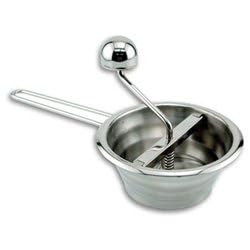
We've all heard about the myriad of benefits of eating organic foods. But even if you've not committed to eating organic yourself, you should seriously consider it for your infants and children. We all want our children to get the best start in life possible. And feeding them wholesome foods grown without chemicals and pesticides is one important way to do that.
Luckily, organic baby food is getting easier and easier to find. Gerber even makes a line of organic baby foods, which Wal-Mart carries, for goodness sake. This article is about six other good options for organic baby foods.
One great option, of course, is making your own baby food. You can use your normal kitchen blender or food processor to make it, or your can buy a hand-cranked grinder for less than $20, which makes preparing baby food on the go fast and easy. You can freeze it in ice cube trays for later, or just make as much as you need for one meal. And because you're not left with mounds of plastic or glass jars, it's a cheap, waste-free way to feed baby!
Image from http://ecx.images-amazon.com/images/I/21YQYAS0EWL._SL500_AA250_.jpg
18 January 2009
The Protein Myth
Moving toward vegetarianism is an excellent way to live more sustainably. Meat is an extremely inefficient use of grains, vegetation, and water. A diet including meat contributes much more to global warming through its carbon footprint than a vegetarian diet does.
If you're considering moving toward vegetarianism, you probably have some questions and concerns. How, for example, do you eat a well-balanced diet rich in all the different types of nutrients you need to be healthy? The article Getting Past the 'Protein Myth' That Keeps People from Quitting Meat and Dairy examines one common concern about vegetarianism: how vegetarians get their protein.
If you're considering moving toward vegetarianism, you probably have some questions and concerns. How, for example, do you eat a well-balanced diet rich in all the different types of nutrients you need to be healthy? The article Getting Past the 'Protein Myth' That Keeps People from Quitting Meat and Dairy examines one common concern about vegetarianism: how vegetarians get their protein.
18 December 2008
For here or to go?

Let's face it. Sometimes we're all just too lazy or too tired to cook a legitimate meal for ourselves. Take-out, of course, is an excellent option. However, the waste that comes along with carrying out food is NOT such an excellent option. No Impact Man gives his advice on the take-out question. [Find the original article here.]
"Take out tubs, individual action, and changing minds"
Yesterday I posted about the trash I'd generated through eating takeout when I got too busy to cook for myself. Someone commented that eating takeout--in itself--is no problem. Cooking at scale may save energy. The problem is the plastic or cardboard containers that get generated.
Commenters left two suggestions behind for ways to get take-out without making trash. One is to take your own reusable containers to the take-out place yourself. I've done this before and the server liked it so much, he gave me extra food.
Another option is to ask the manager of your favorite food place if they would mind keeping a reusuable container belonging to you on hand. That way, they can deliver to you and you don't have to pick it up. When the delivery man drops off your food, you give him back a second, clean container to take back and store until next time.
Here's what's neat about this kind of idea. When you do it, it generates buzz, because other people are forced to get involved. It's like the glass jar I carry for coffee. Everyone wants to talk about it. Same with the reusable takeout tubs. Everyone will want to talk and it's chance to change a few more minds.
Image from reuseablebags.com
Subscribe to:
Posts (Atom)

 Posts


