So, BPA is everywhere. Of course, we know about BPA in plastic water and soda bottles and food storage containers. But it's also hiding in places you might not have considered.
Some hidden sources of BPA:
-Receipts
-Dental work, including sealants and white fillings
-Soda and beer cans
-Food cans (like for canned vegetables, fruits, sauces, etc.)
-Blenders
-And more!
To see a depressing list of 17 unexpected sources of BPA, check out EcoSalon's article.
Showing posts with label plastic. Show all posts
Showing posts with label plastic. Show all posts
13 April 2010

26 August 2009
Printing and Photocopying
Do a lot of printing or photocopying? There are a number of ways you can move toward sustainability:
1. Print/copy less. Yes, it is obvious, but printing or copying fewer pages is the most effective way to be more sustainable in your habits. With the use of computers and the Internet, very few things ever need to be printed anymore. For many people, printing out emails, memos, or bank statements may just be an ingrained habit. If you are in this category, try to reduce your printing by a little each week. Same goes for photocopying. Can you scan the document and keep an electronic copy instead? You may find that you really like having the back-ups, searchability, and space-saving qualities of electronic sources better!
2. Recycled paper. Use paper with the highest recycled content as you can. The most important thing to look for is the percentage of post-consumer recycled content.
3. Reuse paper. Try to always print and photocopy on both sides of a piece of paper if applicable, even if this means you have to manually reload the pages into the machine. This cuts down your paper use by half! Also, if you have one-paged documents that are no longer needed, cut them into quarters and use the blank sides for notes to yourself or others. [This quartering method works great for junk mail, too!]
4. Use less paper. If there's something online that you absolutely must print, consider getting the most "printer friendly" version possible. Some websites already have "printer friendly version" options, but many do not. But there's help! Print Friendly is a free webapp that cuts the page down to only the important stuff. You can use Print Friendly here or learn more about it in this LifeHacker article.
5. Use less ink. This is the newest arrival to the sustainability in printing and copying scene. Ink and toner are not only expensive; they can also be unhealthy. Plus, many companies produce cartridges that cannot be refilled. Every time your cartridge gets empty, you are adding more plastic to the landfills. One way to use less ink is to consider the new "ecofont." This font uses 20% less ink without negatively impacting readability. You can download it for free here.
1. Print/copy less. Yes, it is obvious, but printing or copying fewer pages is the most effective way to be more sustainable in your habits. With the use of computers and the Internet, very few things ever need to be printed anymore. For many people, printing out emails, memos, or bank statements may just be an ingrained habit. If you are in this category, try to reduce your printing by a little each week. Same goes for photocopying. Can you scan the document and keep an electronic copy instead? You may find that you really like having the back-ups, searchability, and space-saving qualities of electronic sources better!
2. Recycled paper. Use paper with the highest recycled content as you can. The most important thing to look for is the percentage of post-consumer recycled content.
3. Reuse paper. Try to always print and photocopy on both sides of a piece of paper if applicable, even if this means you have to manually reload the pages into the machine. This cuts down your paper use by half! Also, if you have one-paged documents that are no longer needed, cut them into quarters and use the blank sides for notes to yourself or others. [This quartering method works great for junk mail, too!]
4. Use less paper. If there's something online that you absolutely must print, consider getting the most "printer friendly" version possible. Some websites already have "printer friendly version" options, but many do not. But there's help! Print Friendly is a free webapp that cuts the page down to only the important stuff. You can use Print Friendly here or learn more about it in this LifeHacker article.
5. Use less ink. This is the newest arrival to the sustainability in printing and copying scene. Ink and toner are not only expensive; they can also be unhealthy. Plus, many companies produce cartridges that cannot be refilled. Every time your cartridge gets empty, you are adding more plastic to the landfills. One way to use less ink is to consider the new "ecofont." This font uses 20% less ink without negatively impacting readability. You can download it for free here.
20 May 2009
PET Plastic Alert
I've published posts in the past that talk about health and safety issues surrounding plastics. Most of the concerns have been about BPA, an estrogen-mimicking chemical.
I hate to be the bearer of bad news, but there is some new data that suggests that PET (#1) plastic also contains an unknown "gender bending" chemical of its own. For more info, check out this Treehugger article.
It really is best to view all plastics as suspect, especially if they touch your food or drinks. Try to use glassware to store leftovers, never expose plastic ware to heat (via the microwave, dishwash, or putting hot food into it), and avoid bottled water.
I hate to be the bearer of bad news, but there is some new data that suggests that PET (#1) plastic also contains an unknown "gender bending" chemical of its own. For more info, check out this Treehugger article.
It really is best to view all plastics as suspect, especially if they touch your food or drinks. Try to use glassware to store leftovers, never expose plastic ware to heat (via the microwave, dishwash, or putting hot food into it), and avoid bottled water.
13 April 2009
Carpets

It's important to pick out carpets and rugs for your home that are environmentally healthy. After all, you spend many, many hours a day breathing around the stuff, don't you?
The problem with carpets: VOCs. Green is Sexy says, "Most carpet is made from petroleum byproducts and synthetics, treated with stain repellents, backed with latex, and padded with PVC." Pretty yucky stuff to let inside your body.
Good options: Rugs made from recycled plastic, like these, are especially good for outdoor spaces. For the indoors, good options include "natural fiber carpets made from chemical-free wool, jute, sea grass, sisal, coir (coconut-husk fiber), and even corn. When the time comes to dump those, you ditch them in the compost" (Ibid). Other natural fiber choices include hemp and reed, like the Japanese Igusa mats.
Certification: Look for the Green Label Plus Certification. "Check the carpet label for a little green house, which means it’s been tested by the Carpet and Rug Institute’s (CRI) Indoor Air Quality testing program" (Ibid). This will ensure your rug is not going to make you sick.
Better options: If possible, you may want to avoid wall-to-wall carpeting all together. Low Impact Living says, "Natural, bare flooring options like reclaimed hardwood flooring or Marmoleum are really the best option from a health perspective–because they don’t trap allergens and chemicals like rugs and carpets do... Cork is a wonderful option because it is a renewable resource, dampens sounds (great for sleeping babies), and is soft on little bodies. Cork is harvested by shaving off the 'bark' of the tree– trees are not killed in the process."
More ideas and details, check out Low Impact Living's great article here.
And no matter what your flooring choices, always leave your shoes at the door to reduce the amounts of pollutants and dangerous chemicals you bring into your home.
Image from http://s7d4.scene7.com/is/image/Gaiam/18-0077?$large$
08 February 2009
Feeding Baby
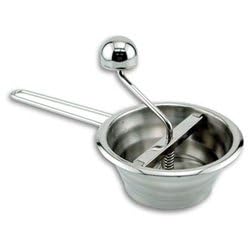
We've all heard about the myriad of benefits of eating organic foods. But even if you've not committed to eating organic yourself, you should seriously consider it for your infants and children. We all want our children to get the best start in life possible. And feeding them wholesome foods grown without chemicals and pesticides is one important way to do that.
Luckily, organic baby food is getting easier and easier to find. Gerber even makes a line of organic baby foods, which Wal-Mart carries, for goodness sake. This article is about six other good options for organic baby foods.
One great option, of course, is making your own baby food. You can use your normal kitchen blender or food processor to make it, or your can buy a hand-cranked grinder for less than $20, which makes preparing baby food on the go fast and easy. You can freeze it in ice cube trays for later, or just make as much as you need for one meal. And because you're not left with mounds of plastic or glass jars, it's a cheap, waste-free way to feed baby!
Image from http://ecx.images-amazon.com/images/I/21YQYAS0EWL._SL500_AA250_.jpg
02 February 2009
Resolutions?
Remember your green new year's resolutions? How are they going? Let me know if I can help!
If you've forgotten yours, or never got around to making one, read over this list from Ecofabulous. Of course, these lists are useful outside of just resolutions though. They help us analyze where we are in our sustainability journey and focus on how to go forward.
Eco Resolutions and Solutions
If you've forgotten yours, or never got around to making one, read over this list from Ecofabulous. Of course, these lists are useful outside of just resolutions though. They help us analyze where we are in our sustainability journey and focus on how to go forward.
Eco Resolutions and Solutions
1. I will stop using plastic bottles and vow to carry my reusable bottle of choice at all times. The NRDC conducted 1,000 separate tests of over 100 bottled water brands and found that the bottled water was not cleaner, purer, or safer than tap water. There have been reports on certain companies simply bottling tap water. So kick the bad bottle habit once and for all. Sigg or Klean Kanteen are great, and lately we’re really loving Earthlust’s custom designs. As an added bonus you can wrap this resolution into the annual “I will save more” declaration and make a jar where each day you put the money you would have spent on bottled water – you’ll be surprised at how it adds up. In 2006, Americans bought 2.6 billion cases of bottled water, totaling $15 billion – a year of plastic bottle money and you may be able to treat yourself to an eco-vacation.
2. I resolve to make at least two small changes in order to use less energy. This year, while you may not be able to install solar panels on your roof, you can make small changes to your energy usage habits that will have a big impact. First, as inefficient incandescent light bulbs burn out, replace them with compact fluorescent bulbs – they last much longer (8-10 times longer) and save money by reducing energy use (typically by 65 to 80 percent). And second, get ride of that haunting phantom load – the electricity wasted when electronics are plugged in but either aren’t on, or aren’t in use (this goes for that fully charged computer or cell phone that’s left plugged in as well). The U.S. Department of Energy estimates that American households use about 43 kWh of electricity each year to power electronics and appliances that are turned off. Plug all your electronics into a power strip and turn it off when the items are not in use – if every American eliminated their phantom load, it would save about $6 billion in electricity costs.
3. Waste: The light green resolution – I will recycle. If you want to take your green routine a shade deeper, then make 2009 the year you start to compost. Really, 2009 holds no excuses for not recycling. Cities and towns are making it easier and easier since most have curbside pick-up. If you are ever in question about whether an item can be recycled, or how to recycle it, check out earth911.com. Encourage your workplace to switch to recycled paper products wherever possible. Since 4 million tons of copy paper are used in the U.S. each year, buying paper with 100 percent recycled fibers uses less energy and water in production and will significantly reduce the number of trees cut down. As for the eco-devotees that are ready for the next step, start to compost your kitchen scraps. According to the EPA, 24 percent of the waste Americans send to landfills is organic waste. We love the Can-O-Worms in-house compost bin. It’s a great way to start reducing your landfill contributions by almost a quarter!
4. If I can schedule in time for the gym and happy hour drinks with friends, I can schedule in the extra time needed to walk or bike to work. Give the road rage a rest and try committing to an alternative form of transportation once a week. Ideally, the carbon-free route is best (with a little added endorphin boost for the traditional “exercise more” resolution) but taking the bus or train will still help to minimize your carbon footprint – according to the American Public Transportation Association, using public transportation saves 1.4 billion gallons of gasoline each year.
5. I will resolve to consider where my food comes from and how it is farmed. Ideally, supporting seasonal, local agriculture from organic, sustainably managed farms is best. This doesn’t have to mean a weekly trip to the farmer’s market – you can sign up for a CSA or simply make a conscious choice at the grocery store when looking at that apple from New Zealand. As you are committing to cut back on your carbon-emitting transportation, try to cut back on your food’s footprint as well. Where it is coming from and the amount of toxic pesticides used are both contributing factors to how much waste and carbon emissions are generated – one study by the Rodale Institute found that organic farming reduces carbon dioxide by using 37 percent fewer fossil fuels than conventional farming.
02 January 2009
More green resolutions
Still haven't found the right new year's resolutions for you this year? Skim through this article from Low Impact Living. They've divided their list into two categories: light green "aspiring Jedi" (beginning steps) and green Jedi (slightly more challenging ones, to aim for after completing the light green ones). Yeah, it's nerdy. Gotta love it. Plus, it is full of links to tons of other resources to help you on your journey to sustainability.
Green New Year's Resolutions for 2009
For the Light Green, Aspiring Jedi (May the Force be with you!)
1. Put your outdoor lights on motion sensors. Do you need to light the night and burn all of that electricity? No, but you do want safety. Motion sensors are the answer. You’ll save energy and money, too. And if you want to go a step beyond this, you can get LED lights—which are ultra-efficient. Check LED lighting out here.
2. Wash your laundry in cold water. We swear it works! Washing machines are major power hogs in our homes and using cold water is a great, easy way to reduce your energy use. (If you want to go a step beyond this you can even start to air dry your laundry. This will help your clothes last longer and save even more energy. Find great drying racks here.)
3. Take reusable grocery bags to the store. This one is so easy and I still can’t believe how few people do it! Reusable bags will cut down on the use of over 500 plastic bags per person per year (and don’t forget plastic is made from petroleum) or save a slightly lesser number of paper bags. One 15-year-old tree only yields 700 paper bags! You can find reusable bags here.
4. Start using renewable energy at home. There are several ways you can get on board with green power. Many utilities now offer green power alternatives for a nominal monthly fee. Check with your local utility to see if this is an option. Click here to learn more about buying green power from your utility.
5. Make sure you’ve swapped out all of your light bulbs for energy-efficient models. Most people don’t realize that lighting accounts for 15-20 percent of a home’s energy use. So there’s a major opportunity to save money and electricity with better bulbs. Compact fluorescents use 1/4 of the energy and last up to 10 times as long as normal bulbs. And LED lights are 2-3 times as efficient as compact fluorescents. And they come in all shapes, sizes and colors–find them here.
For the Green Jedi
1. Join a CSA or plant an organic vegetable garden. Why not make this the year that you decide to eat the freshest, healthiest, most local produce you can? You can either join a CSA (Community Supported Agriculture) program and get your produce from a local farmer, or you can go a step further and grow your own! Planting a vegetable garden will fill your kitchen with yummy produce and cut down on the carbon emissions from transporting the vegetables you normally buy. Click here to read our useful guide to starting an organic garden of your own.
2. Read your newspapers online. Or just convert to online for your weekday editions and keep your weekend papers to enjoy with your Sunday coffee. You’ll save trees, energy, and money! If only 10 million people in the US cancelled their Monday-Friday newspapers, we’d save almost 50,000 trees each year.
3. Find a way to drive and fly less and cut your carbon emissions this year. Can you bike to the grocery store? Can you walk to the bank? Can you talk your boss into letting you telecommute once a week? Better yet perhaps you can talk your boss into creating a telecommuting plan for your whole department? Or propose that you have meetings via teleconference rather than flying. Remember that the emissions from flying are a major contributor to global warming. Click here to learn about other ways to spread the good green word at work– Learn more about how to green your office.
4. Install a programmable thermostat. These nifty devices allow you to micro-control your home’s heating and cooling. One of these can help you shave 15% off of your energy consumption (and save you money!). It’s really quite simple to install—will take you only 45 minutes. Find programmable thermostats here, and learn how to install them here.
5. Really investigate solar and wind energy options for your home. Many of us have told ourselves that we simply can’t afford solar or wind energy. (And this certainly may be true.) But incentives have gotten much better in some parts of the country and costs have also come down. If a full solar electric system is too expensive, consider a solar hot water system—which can be $4-6K to install and reduce your home energy use by 20-30%. Learn more about solar hot water here. And to get a quote on installation costs, you can find solar installers near you here and wind system installers here.
16 December 2008
Holiday lights and trees

The holidays are close upon us now. If you're still thinking about getting some lights or a tree for this year, learn how to make your holiday more eco-friendly. Even if you're done decorating for the season, take note of these tips for next year. (Plus, the days after Christmas can be a great time to stock up on more sustainable holiday supplies for future years.)
Holiday lights: Look for LED light strings. All the arguments for LED lights over incandescent bulbs in your house still apply. They are cheaper to run, they use less energy, and they last practically forever. And year by year they are easier and easier to find in stores. Home Depot, for example, has a TON of options. So do Sears and Kmart.
Trees: This is a tough one. A really tough one. In fact, there are very few good options here. You could forgo the tree although, the best option, or you could decorate a tall potted plant instead. But if you must have an honest-to-goodness Christmas tree, there's a lot to consider.
First, consider an outdoor potted tree that you can bring in for the week before Christmas. Or planting your own Christmas trees. In six or so years, you'll be able to harvest your first one, and, so long as you plant one a year, you'll be set from then on out. Both of those options are realistic for the suburban or rural homeowner.
If you live in an urban area, an apartment, a rental property, or a condo, you have a different set of options. Some cities have Christmas tree rental programs where you can have a live potted tree in your home for the holidays, then send it back out to pasture, so to speak, for the rest of the year. This is a great program. Your next-best option after that is an organically-grown tree. These are getting easier to find.
If none of the above options work for you, you are now in a toss-up situation: conventionally-grown chopped down tree vs. artificial tree. Conventional tree farms use a ton of chemical pesticides and herbicides. Most conventional trees to reach your neighborhood also had to be shipped a long way, leaving a large carbon footprint behind. If you choose to go with this option, buy the most local tree you can, and research how to environmentally dispose of it (using a wood chipper to produce mulch is good, as are programs that use them for fish habitats in lakes -- see what's available in your area).
Artificial trees offer much more convenience and can be used year after year. However, most are made of unsustainable plastic, contain lead, and are produced in China. Again, the carbon footprint of that transportation is large. If you choose to go with this option, make sure you take good care of your tree so that you may use it for decades. Also, do not buy a new one. Look for one at thrift stores or through the classifieds (Craigslist counts too!). In this way, you are not adding to the ecological impact of your tree. In fcct, you are taking it out of the waste system, which is always a good thing.
For more of Christmas trees, check out this article from Green Promise.
For ideas on green tree-trimming and home decoration, see Crunchy Chicken's article Greening Your Holiday Decorations.
Image from http://www.thelasvegasadventurer.com/wp-content/uploads/2007/12/tree_recycle.jpg
18 November 2008
Cans and BPA
Ok, so I am thoroughly freaked out. I basically live off of soup for lunch...everyday. But that's going to change after this week. Turns out that food cans are almost ALL lined with BPA-laden plastic. I should have known, but I've been in denial. Surely, the organic brands I live on wouldn't use BPA in their cans. Nope...
Skim through this article to see whether or not your favorite canned food/soup company uses BPA-free cans. Campbell's, Swanson, Nestle, and Carnation cans do use BPA, of course. But so do Amy's, Muir Glen, Wolfgang Puck, Whole Foods/365, and Annie's.
So, what do you eat for lunch??
Skim through this article to see whether or not your favorite canned food/soup company uses BPA-free cans. Campbell's, Swanson, Nestle, and Carnation cans do use BPA, of course. But so do Amy's, Muir Glen, Wolfgang Puck, Whole Foods/365, and Annie's.
So, what do you eat for lunch??
14 October 2008
Sustainable Lunches

Bringing your lunch with you to work or school has the potential to greatly reduce the amount of trash you produce. At home you can buy in larger bulk and separate food into single-serving sized reusable containers.
Ben and I have made a few steps in the right direction so far as lunch is concerned. We use reusable lunch boxes instead of paper bags; we bring cloth napkins instead of paper ones; we use glass food containers to transport last night's leftovers; we tote real silverware to and from work; we wash and reuse our plastic baggies. Yet we know we still have a long way to go.
Want a little help getting started with making your lunch more sustainable? Check out "Kids Konserve." You can find cloth napkins, reusable lunch sacks, stainless steel drink bottles, single-serving sized non-plastic food containers, and even "food kozies," which the site describes as "reusable alternative to plastic baggies, plastic wrap and foil...recycled, FDA approved, non-toxic, non-leaching, recyclable PE plastic...does not contain Bisphenol-A (BPA)."
The site even has a waste-free lunch kit that includes everything you need to get started.
So when your box of Ziplocks is running low or your package of paper napkins is empty, move toward a more sustainable lunch routine. And I, for one, would love to get my hands on a couple of food kozies!
UPDATE: To-Go Ware also offers an exciting line of dishes and flatware for the road. Check out their beautiful array of bamboo forks, spoons, chop sticks, and knives in lovely recycled plastic wraps. They also have stainless steel containers with snug tops that are perfect to bring your lunch with you to work or for bringing home left-overs from a restaurant.
08 October 2008
Reducing Plastic in Your Life
Life Less Plastic is an inspiring (if irregular) blog about one woman's journey to live completely plastic-free. She recently had an article for the Dallas Morning News, and I'm including the text below.
I think we all can identify with her sentiments, being at times overwhelmed and discouraged by the magnitude of our unsustainable habits. But that's not the whole story. We also get to feel accomplishment every time we make lifestyle changes, even small ones. We get to live healthier, more wholesome, more fulfilling lives because of our efforts.
I think we all can identify with her sentiments, being at times overwhelmed and discouraged by the magnitude of our unsustainable habits. But that's not the whole story. We also get to feel accomplishment every time we make lifestyle changes, even small ones. We get to live healthier, more wholesome, more fulfilling lives because of our efforts.
How I Gave Up Plastic
by Jeanne Haegele
Bad habits are hard to break, but sometimes you just have to try. At least, that's what I've been telling myself for the past year as I've attempted to give up plastic.
Why on earth would anyone give up plastic? There are ample reasons.
Americans send huge amounts of plastic to landfills each year – almost 60 billion pounds in 2006 alone. Some plastic never biodegrades, and most of what does takes hundreds of years. It is difficult to recycle, and evidence of plastic's negative health effects is mounting. Then there's the Great Pacific Garbage Patch – a vast, swirling soup in the Pacific Ocean where wildlife is threatened by plastic refuse trapped in the currents.
Last autumn, thinking over these worrisome facts on a bike ride through the streets of Chicago, I started to wonder whether it would be possible to live without plastic. It seemed unlikely, especially since everything in the supermarket is wrapped, if not double-wrapped, in the stuff. How could I avoid it?
But I decided to go for it. I would conduct an experiment and give up everyone's favorite polymer.
Looking back now at those first few months, I understand why people feel green fatigue. Learning to live without plastic wasn't easy. I had to throw out so many of my old routines and rethink fundamental aspects of my life.
Grocery shopping was my greatest challenge. I remember my initial trip to the the supermarket, when I first learned that so many of my normal standbys were off-limits. Crackers, chips, cookies, pasta and dozens of other favorites were out, and I had no idea what to buy. Only a few items came home with me that day – and even some of those, like the canned tuna and milk, had hidden plastic in their packaging (aluminum cans and paper milk cartons are lined with a thin layer of plastic). I spent those first few weeks a bit hungry.
But with some practice, grocery shopping became surprisingly easy. Fruits and veggies are a much bigger part of my diet now, and I've discovered that several stores in my area have bulk bins with enough products to keep me happy – cereal, oatmeal, granola, nuts, dried fruit, oatmeal, rice and chocolate candy are some of my favorites. And I still buy milk (in a glass container) and meat (wrapped in paper at the deli), and use my own cloth produce and grocery bags. Eating well has been not a problem – and the cost savings are significant.
Groceries haven't been my only dilemma, though. Most of my favorite toiletries are packaged in plastic. Searching for a shampoo replacement has been a constant struggle, and conditioning my hair with a vinegar solution, while effective, makes me worry about smelling like a salad. And do you know how hard it is to find plastic-free makeup? Difficult enough that I've basically given up. Still, even these have been changes for the better; I use very few toiletries now, and I am, once again, saving a lot of cash.
So, like kicking a nail-biting problem, I gave up plastic – a bad habit that was hurting the environment – and I'm stronger for it. I've tested my boundaries, forced myself to think critically about my actions and developed a simpler way of life. I'm happier and healthier than ever.
I know I have more bad habits, still unnoticed or unchecked. But with a little effort, I know I can get rid of them, too. It just takes a true dedication to change, little by little. A commitment to drive less, adjust my thermostat, even eat less meat.
At first, breaking these habits will seem difficult; it did when I gave up plastic. But this experiment has shown me that the hardest thing about making changes is breaking old patterns, patterns that comfort you or help you make mundane decisions but don't truly influence your quality of life. Getting greener seems difficult at first, but it only takes small steps to get you on your way.
As for me, the more steps I take, the less I miss the old bad habits. And the more I learn that it's not the minor hardships that matter in the end.
19 September 2008
Plastics and Your Daily Toilette

Your daily hygiene routine is probably one of the major sources of plastic waste in your life. You use your shampoo and body wash. You slick back your hair with hair gel. Or perhaps you squeeze some concealer, foundation, and lotion into your hands. Plastic bottles all.
Eco-Chick's article Nix Plastic from your Beauty Routine to the rescue!
-Next time you run out of shower gel/body wash, consider replacing it with bar soap. Minimal packaging. Use a washcloth with it or get two bars if you can't stand to think about sharing one with your significant other.
-If you're feeling adventurous, experiment with solid shampoo bars. You can find them from Burt Bee's, Herbaria, Oyin, Lush, and more. Easy to use, and oh-so-much-easier to take on an airplane!
-Buy items like hand soap in bulk.
-Consider branching out to multi-use products. Again, this reduces packaging. Plus, it'll be great for your subconscious to have fewer "things" in your life. Many make-up products can be multi-use; many solid shampoo bars can also be used as your primary shower soap too; make sure your lotion has sunscreen in it; etc.
20 August 2008
Handy Pocket Guides
With so many unsustainable features of American culture, it can be daunting to try to remember what's good and what's harmful in any given sector. Luckily, there's help. Experts can focus on one issue at a time and boil their recommendations down to handy-dandy pocket-sized guides.
From seafoods to plastics, produce to cosmetics, check out these pocket guides from Green Home.
From seafoods to plastics, produce to cosmetics, check out these pocket guides from Green Home.
19 August 2008
More Diapers!
This weekend we visited our parents' homes, and my in-laws mentioned my blog. I think they've absorbed a thing or two from it, which is great. But my father-in-law actually ridiculed our view about cloth diapers, saying that he bets we will change our minds when we have our first baby. Sure, a funny joke, but a little insulting, in light of all the changes we have already made and those that we will continue to make in the seven to ten years between now and when we have children. I cannot imagine using disposable products now, let alone in a decade!
But on the way home from our trip, Ben and I discussed the diaper issue again. We said that no matter how strongly we feel on the issue, it would be irresponsible to claim that we know we'll use cloth diapers for our children. We can, however, know that we use rags instead of paper towels, cloth napkins instead of paper ones, cloth menstrual pads instead of disposable products. In other words, we have an ever-improving track record on very comparable issues.
However, as on many issues, we believe that in ten years there will be a completely different range of products and options from which to choose. Maybe we would use disposable diapers if they were biodegradable, compostable, and made from 100% post-consumer materials. [Check out Nature Babycare for a pretty good disposable option like this.] We don't know what our set of options will be then. In 2008 though, cloth is our best choice.
Enter Earth 911's article "Another Player in the Diaper Dillema." The article introduces a third option: flushable diapers. They combine a cloth outer diaper with a plastic-free, flushable insert. Pretty good option, eh? Check them out!
But on the way home from our trip, Ben and I discussed the diaper issue again. We said that no matter how strongly we feel on the issue, it would be irresponsible to claim that we know we'll use cloth diapers for our children. We can, however, know that we use rags instead of paper towels, cloth napkins instead of paper ones, cloth menstrual pads instead of disposable products. In other words, we have an ever-improving track record on very comparable issues.
However, as on many issues, we believe that in ten years there will be a completely different range of products and options from which to choose. Maybe we would use disposable diapers if they were biodegradable, compostable, and made from 100% post-consumer materials. [Check out Nature Babycare for a pretty good disposable option like this.] We don't know what our set of options will be then. In 2008 though, cloth is our best choice.
Enter Earth 911's article "Another Player in the Diaper Dillema." The article introduces a third option: flushable diapers. They combine a cloth outer diaper with a plastic-free, flushable insert. Pretty good option, eh? Check them out!
Subscribe to:
Posts (Atom)

 Posts
Posts


